
28.04.2026
New Success Story: ATOSENS
The M-ERA.NET ATOSENS project aims for an advanced intelligent gas sensing concept based on an in-sensor computing architecture, addressing key limitations of conventional gas sensing systems, such as high-power consumption, reliance on external data processing, and limited real-time capability.
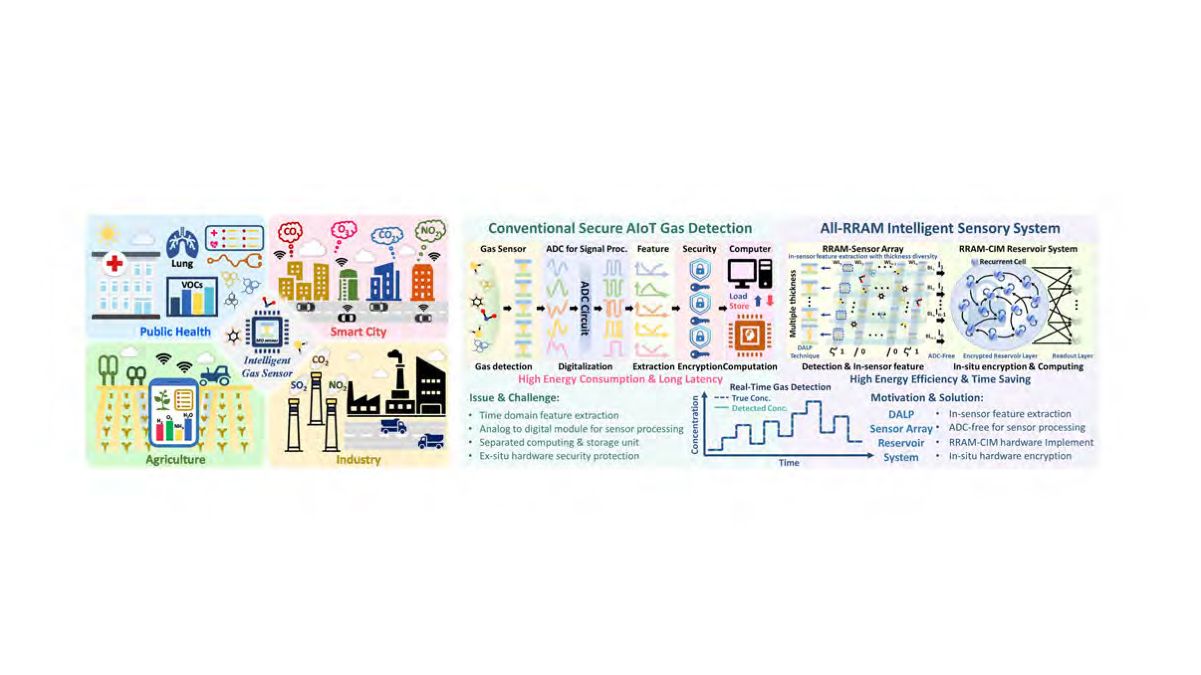
In this project, the researchers adopted a novel thin film fabrication technique – direct atomic layer processing (DALP) – enabling localized, atomic layer deposition of TiO₂ films for H2 sensors. This additive nanofabrication approach enables lithography-free, scalable fabrication of sensor arrays with precisely engineered material properties, while significantly simplifying the overall process flow. The resulting vertical TiO₂-based RRAM sensors exhibit high sensitivity to hydrogen, combined with rectifying diode behaviour that enables dense, transistor-free array integration. A distinctive feature of the developed system is the exploitation of thickness-dependent sensing characteristics to generate diverse, physics-based features directly within the sensor array. These features are processed in-situ using an RRAM-based in-memory computing platform implementing reservoir computing, allowing real-time gas concentration detection with high accuracy while minimizing data movement and latency. By eliminating the need for analog-to-digital converters and external feature extraction, the system significantly reduces hardware complexity, energy consumption, and system footprint, making it highly suitable for edge deployment.
Read more about the success stories of projects funded within the M-ERA.NET Calls: here