Biogenic Inks combining marine collagen and ionic-doped calcium phosphates for bone tissue engineering- BiogenInk
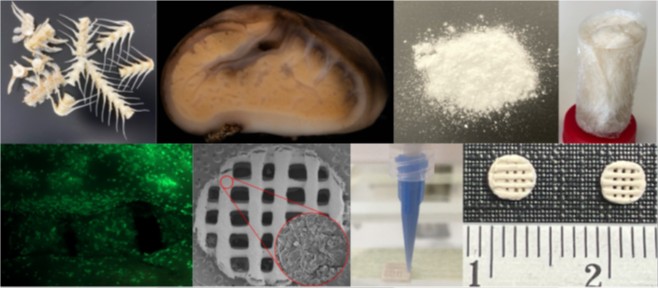
Although 3D printing is arising as a versatile and potent technology for production of biomaterials, in particular tissue engineering (TE) scaffolds, its maturation is still hampered by the limited materials that can be used. BiogenInk project addressed this scientific challenge by aiming the development of bioinspired and bioresorbable inks composed of marine collagen and ionic-doped calcium phosphates, as building blocks for the production of cell instructive scaffolds for bone regeneration. To accomplish this, firstly a sustainable raw materials pipeline was established to produce marine collagen and fish bones, using marine demosponges (Chondrosia reniformis Nardo, 1847) from an integrated multitrophic aquaculture system and fish bones as byproducts from the industrial processing of cod for food products, respectively. In particular, marine sponges were used for bioremediation in a fish aquaculture - with environmental benefits - and a specific collagen extraction procedure was designed and applied to the resulting biomass producing the valuable biopolymer. In parallel, a methodology for valorization of fish bones - industrial by-product - was proposed, based in calcination, to generate calcium phosphate (CaP) powders, with environmental and economic advantages. Then, composite materials was produced by combining marine sponge collagen with fish bones CaP, with different formulations being studied to enable the use in 3D printing while mimiking the composition of bone extracellular matrix. These formulations comprised also alginate, a non-toxic, biodegradable and biocompatible natural polysaccharidecrosslinkable with divalent cations to generate the required shear-thinning materials, as well as doping of fish bones with strontium ions to improve their biological activity. The composition of the inks has been established and validated in 3D printing procedures, generating scaffolds capable to support the tridimensional culture of osteoblast-like cells in the perspective of bone tissue engineering. Overall, the BiogenInk consortium testifies the strength of joining different scientific backgrounds (and geografies), from marine biology and biotechnology to materials engineering and biomedicine, contributing not only to increase the awareness on the biotechnological relevance of marine biological resources, identifiable as blue natural capital, but also by offering new biomaterials and 3D printing procedures based in imaging data as promising tools for the arising new therapeutic paradigm of precision and regenerative medicine.