
Development of a novel organs-on-a-chip platform for nanodrug delivery and functionality testing to treat Parkinson's disease - nanoPD
The nanoPD project focuses on modeling biological barriers in vitro using multi-compartment microfluidic chips containing human midbrain organoids to develop new theranostics for Parkinson's Disease (PD). These organoids, derived from PD patient-specific induced pluripotent stem cells (iPSCs), exhibit neurodegeneration phenotypes, allowing for personalized disease modeling. The project investigates the capability of Nanodrug Delivery Systems (NDDSs)—including magnetic nanoparticles (MNPs) conjugated with synthetic receptors and nanorobots—to cross the blood-brain barrier (BBB) and deliver therapeutic agents to target tissues. To monitor efficacy and barrier integrity, the platform integrates molecularly imprinted conductive polymers (e.g., PEDOT or PANI) with hierarchical structures onto Fin Field-Effect Transistor (FinFET) arrays. These sensors incorporate two-dimensional transition metal dichalcogenides (2D TMDs) to enhance sensitivity and limits of detection. This approach aims to elucidate drug mechanisms against protein aggregation and kinase inhibition while advancing the Technology Readiness Level (TRL) of personalized precision medicine technologies.
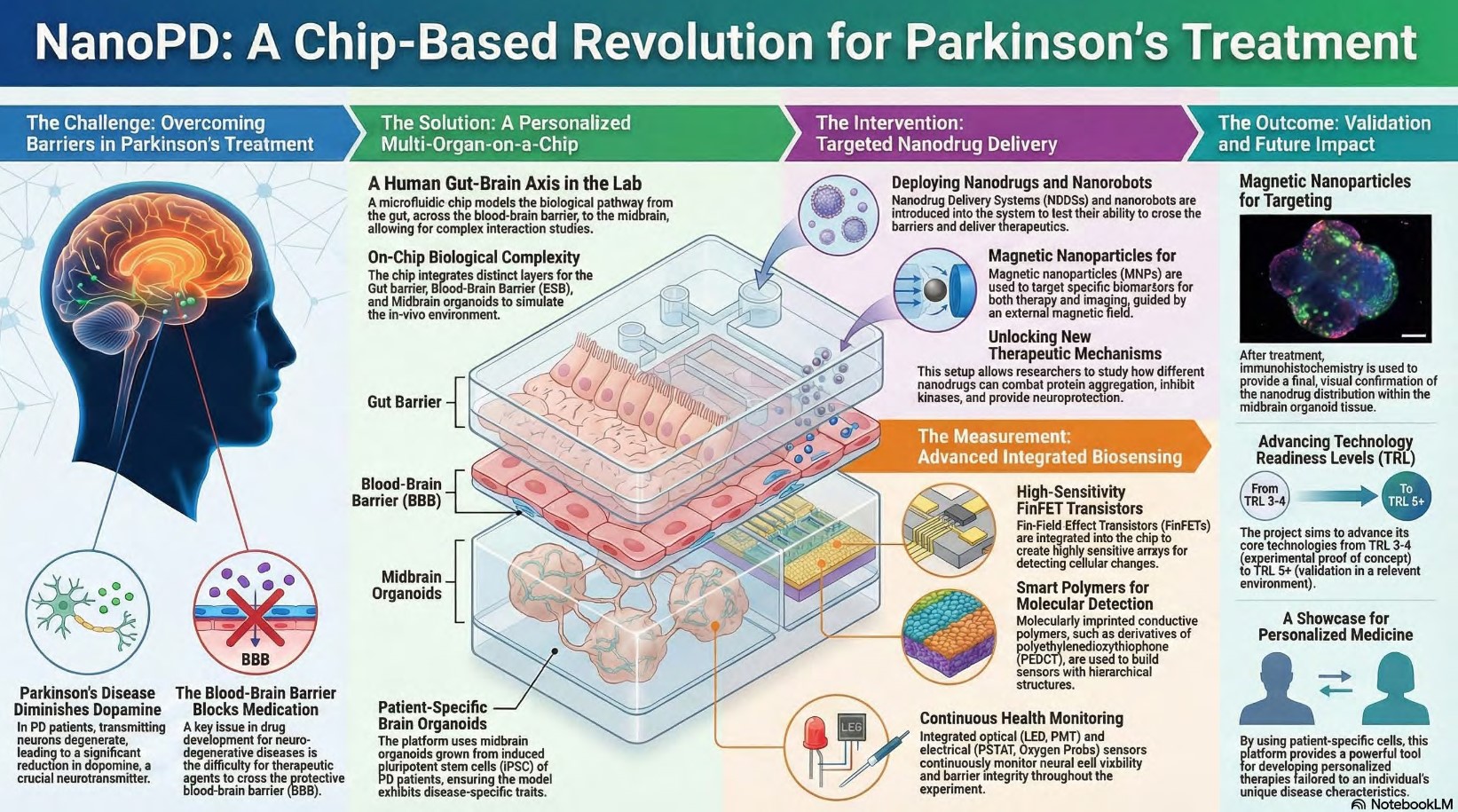
Specific Success: The project has achieved significant milestones in high-quality publications and patent applications, particularly in developing sensors for PD biomarkers and organoid-on-a-chip technologies:
(1) The research team has published multiple high-impact papers demonstrating the successful integration of sensing technologies with brain organoids:
- Organoid Sensing: Developed a technique for the epitope imprinting of Alpha-synuclein to sense the protein directly in the culture medium of Parkinson's brain organoids. M.-H. Lee et al., "Epitope Imprinting of Alpha-synuclein for Sensing in Parkinson's Brain Organoid Culture Medium," Biosensors and Bioelectronics, 175, 112852, 2021.
- Therapeutic Applications: Demonstrated cellular therapy using imprinted composite nanoparticles to remove α-synuclein in in vitro models. M.-H. Lee et al., "Cellular Therapy Using Epitope-Imprinted Composite Nano-particles to Remove α-Synuclein from an in Vitro Model," Cells, 11, 2584,
2022. - Advanced Materials: Utilized peptide-imprinted conductive polymer nanotubes for detecting α-synuclein in human brain
organoids. M.-H. Lee et al., "ACS ANM, 3(8), 8027-8036, 2020 (SCI). - Barrier-on-a-Chip: Reviewed and advanced the use of
sensors in Blood-Brain Barrier-on-a-Chip devices. A. Kincses et al., "Biosensors, 13(3), 357, 2023.
2) The project has generated intellectual property regarding sensing films and methods for PD-related biomarkers:
- α-Synuclein Sensing: Patents secured and applied for regarding α-synuclein sensing films, manufacturing methods, and uses: US Patent,
#17/328,330 (2025); PRC Patent, CN113759126B (2021); ROC Patent, I745993 (2020). - Patents for sensing DJ-1 and LRRK2 using peptide-imprinted polymers and 2D material doping: ROC Patent: I909520 (2025) and I905609 (2025).