Safe Composite Pressure Vessels with Self Structural Health Monitoring Capacity - HYMOCA
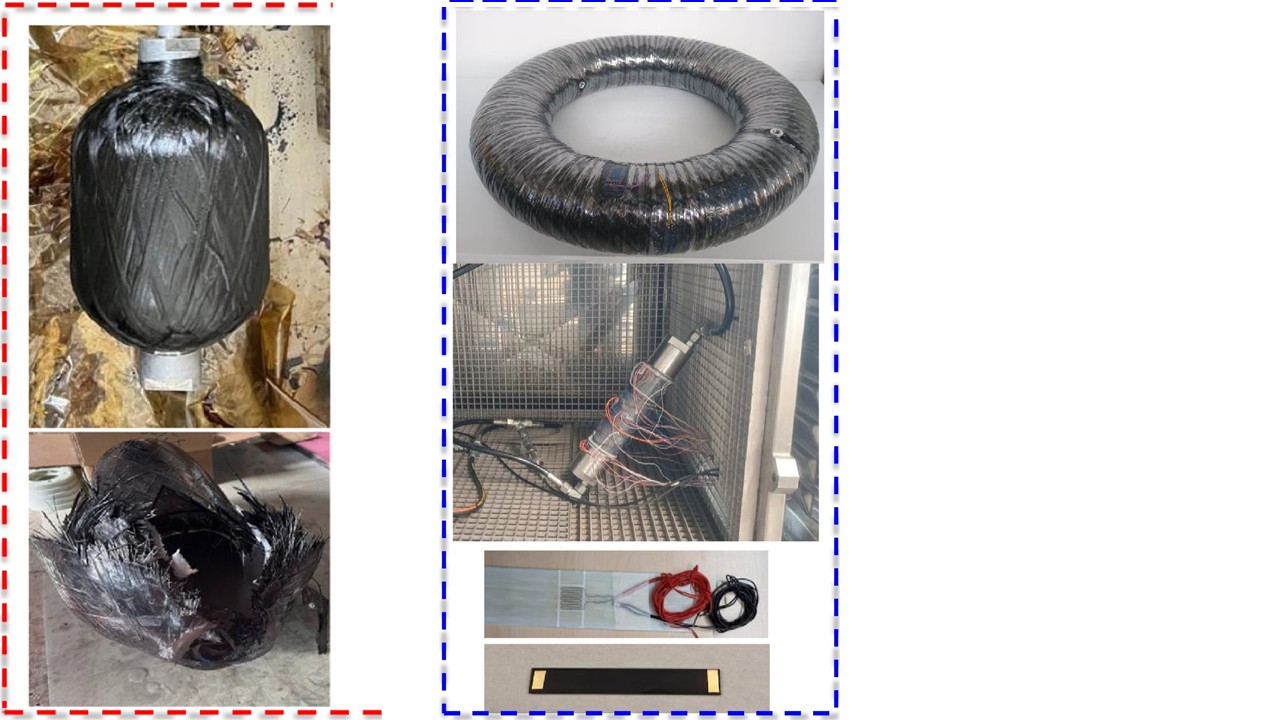
Hydrogen is a low-carbon energy carrier and one of the key energy solutions for the 21st century, offering a viable alternative to fossil-fuel-based economies. Onboard hydrogen storage relies mainly on high-pressure Type IV composite overwrapped pressure vessels (COPVs). This technology is mature but still costly, and it requires further R&D to improve performance, durability and cost-effectiveness. The HYMOCA project addressed this challenge by developing a new class of smart COPVs with enhanced durability and built-in sensing capacity. The project advanced the technology from TRL3 to TRL5, with validation in a relevant industrial environment. A five-partner consortium from Luxembourg, Türkiye and Germany carried out the work. It combined expertise in nanomaterials, modelling and simulation (LIST), composite processing and design (İzmir Institute of Technology, IZTECH), sensor integration and structural health monitoring (Fraunhofer IWU), and winding, prototyping and validation testing (Lightweight Structures Engineering, LSE, and IZOREEL). The project developed nanomodified composite materials with self-sensing capability and manufactured more than ten hydrogen tank prototypes, which were successfully burst tested. The sensors showed good sensitivity, a large strain range and stable behaviour over millions of fatigue cycles.
These results were obtained with a newly developed fatigue-testing device. They were supported by numerical simulations and tests on composite tubes, and the approach is now being transferred to toroidal (donut-shaped) tank geometries. The work led to 12 peer-reviewed papers, 10 conference contributions, 2 degrees and 2 book chapters. HYMOCA has also had tangible follow-on impact. LIST invested in a large-scale Automated Fibre Placement (AFP) machine and a tape/towpreg line, which strengthens its composite manufacturing capabilities. LSE and IZOREEL invested in dedicated equipment and approaching commercialision of their products. The self-sensing technology developed by LIST is also being explored for structural monitoring beyond hydrogen storage. This project was funded by the Luxembourg National Research Fund (FNR), the Scientific and Technological Research Council of Türkiye (TÜBİTAK), and the Saxon State Ministry for Science, Culture and Tourism (SMWK), Germany.
Project details